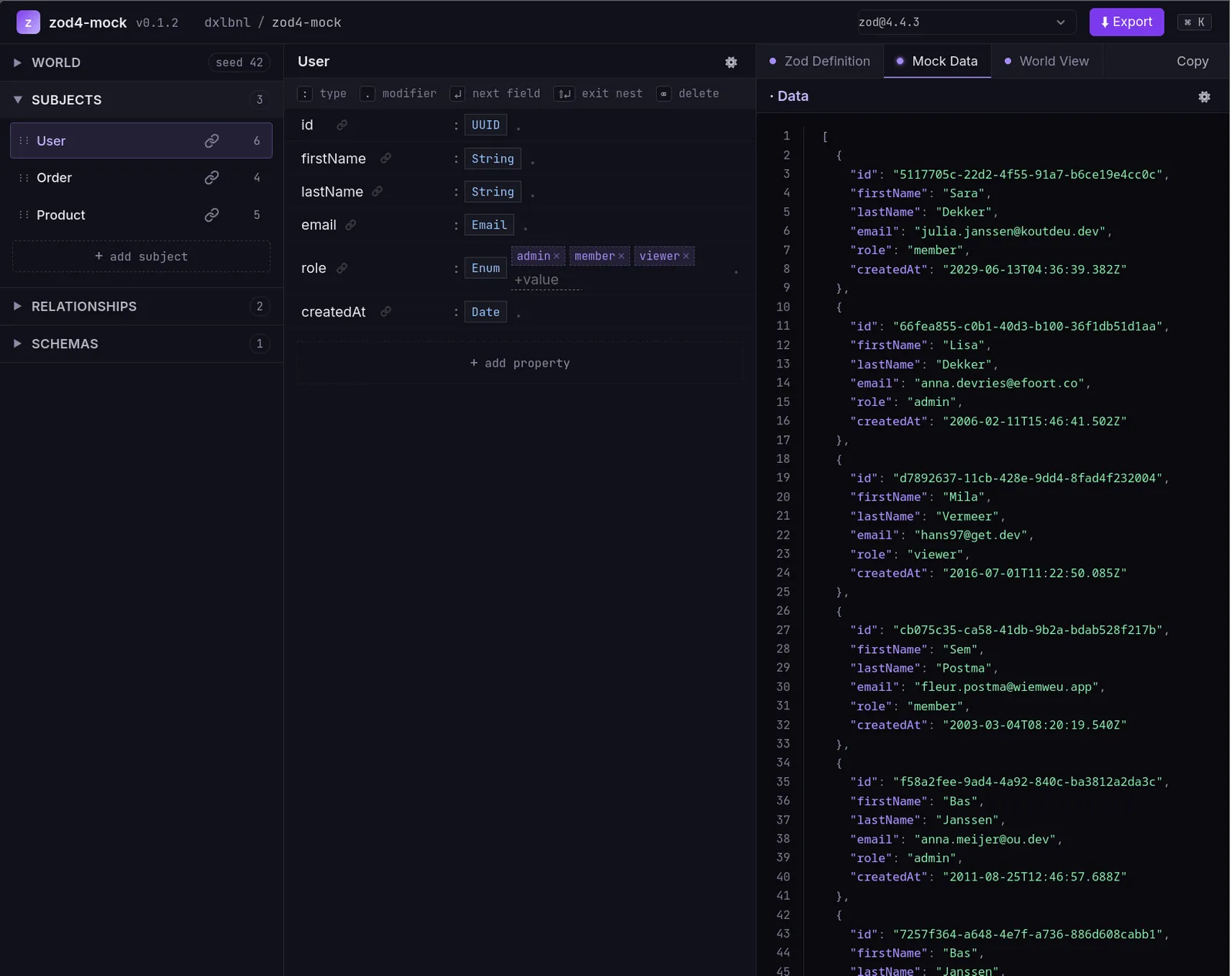
At work, we had a nice setup for mock data in Zod 3, but upgrading to Zod 4 broke almost everything. Existing libraries like zod-mock or zod-fixture often had two big issues: modifying a schema would cause the generated data to shift completely, and getting referential integrity—like matching IDs between a User and an Order—required a ton of manual glue code.
I built zod4-mock to fix both.
Zero-config by default
The simplest way to use it is just generate. It uses heuristics based on your field names to guess what the data should look like:
import { z } from 'zod';
import { generate } from 'zod4-mock';

const UserSchema = z.object({
  id: z.uuid(),
  firstName: z.string(),
  email: z.email(),
  role: z.enum(['admin', 'user']),
  createdAt: z.date(),
});

const user = generate(UserSchema);
// → {
//     id:        'a3f1c2d4-9e6b-4a0f-b821...',
//     firstName: 'Jan',
//     email:     'jan.bakker@dexterlabs.nl',
//     role:      'user',
//     createdAt: 2026-05-12T16:43:01.000Z
//   }
The world model
For real testing, you want determinism. You create a “world” with a seed, and it produces byte-identical output every time, on every machine.
import { z } from 'zod';
import { createWorld } from 'zod4-mock';

const PersonSchema = z.object({
  id: z.uuid(),
  firstName: z.string(),
  lastName: z.string(),
  email: z.email(),
});

const world = createWorld({ seed: 42 })
  .withSchema(PersonSchema);

const people = world.generate(
  z.array(PersonSchema).min(3).max(10)
);
Cross-API consistency
Where this really pays off is when you have multiple schemas representing the same underlying entity. Instead of manual wiring, you can use from to derive one schema from another:
const PersonSummarySchema = z.object({
  personId: z.uuid(),
  displayName: z.string(),
});

world.withSchema(PersonSummarySchema, {
  from: PersonSchema,
  matchers: {
    personId: (ctx) => ctx.source.id,
    displayName: (ctx) =>
      `${ctx.source.firstName} ${ctx.source.lastName}`,
  },
});

const summaries = world.generate(z.array(PersonSummarySchema));

// true — always
console.log(people[0].id === summaries[0].personId);
The world tracks the mapping automatically. You can also use relations to link IDs across entirely different entities (like authorId in a Post schema).
Like zod-fixture, the library is aware of field names. 150+ keys like email, firstName, createdAt, street, and postalCode produce realistic values automatically. You can register your own matchers globally or per-schema:
world.withSchema(ProductSchema, {
  matchers: {
    sku: (ctx) => `SKU-${ctx.gen.string.alphanumeric(6)}`,
    price: (ctx) => ctx.prng.int(100, 50000),
  },
});
ctx.gen gives you access to a full library of generators (person, location, finance, etc.) already wired to the world’s seed.
Recursive schemas and entropy
The latest update finally adds support for recursive (self-referential) schemas, so you can mock complex tree structures or nested comments without stack overflows. We’ve also increased the data entropy significantly—no more getting the same three names in every test.
No heavy dependencies
Most mock libraries pull in faker, which is massive and can slow down test suites. zod4-mock includes a lightweight, built-in generator with the same capabilities, keeping your dependencies small.
Built for Zod v4, MIT licensed, TypeScript-first.
npm install zod4-mock